Stockholm’s Underground Art: The Easiest Way to See the Best Tunnels

Stockholm had been on our list for ages, but one of the biggest reasons we finally booked it wasn’t the museums, the islands or even the food; it was the underground art. Once we arrived, it didn’t take long to realise that exploring the metro stations is honestly one of the most fun, easy and unique things to do in the city.
You don’t need a tour (there are some you can book), you don’t need hours, and you definitely don’t need to be an art expert. You just hop on the train, and suddenly you’re standing inside these incredible cave‑like stations painted in neon colours, giant murals, sculptures and whole worlds you’d never expect to find underground. It became one of our favourite parts of the trip, simple, affordable, and such a brilliant way to see a different side of Stockholm.
Travel Made Easy: Using the Stockholm Card for the Metro Art Trail
We bought and used the Stockholm Card during our trip, and honestly, it made getting around the city (and exploring all the underground art) unbelievably easy. The tickets were stored on an app on my phone, so we just tapped through the barriers and hopped on and off wherever we wanted. No queues, no faff, no trying to figure out ticket zones.
The card covers unlimited travel on the entire public transport network; the underground (Tunnelbana), commuter trains, trams, buses and even some local ferries. It’s perfect if you’re planning to explore a lot in a short time. For us, it meant we could jump between the best art‑filled stations without thinking about cost or buying separate tickets.
A Little History of Stockholm’s Underground (Tunnelbana)
Stockholm’s underground system, the Tunnelbana, is often called the world’s longest art gallery, and it genuinely lives up to the name. The network opened in the 1950s, but the real transformation began in the 1970s when artists were invited to turn the stations into bold, colourful, cave‑like spaces that felt welcoming, creative and uniquely Swedish.
Today, around 90 of the 100 stations feature some form of artwork, everything from painted bedrock ceilings and huge murals to mosaics, sculptures and entire themed environments. It’s all designed to be accessible to everyone, not tucked away in a museum, but right there on your daily commute.
The Tunnelbana is split into three main lines, each with its own colour:
- Blue Line (T10 & T11) – home to some of the most dramatic, photo‑famous stations
- Red Line (T13 & T14) – a mix of modern art, bold colours and big open spaces
- Green Line (T17, T18 & T19) – the oldest line, with classic stations and early artworks
Together, they weave across the city and out into the suburbs, making it incredibly easy to hop between the best art stations, especially if you’re using a Stockholm travel card.
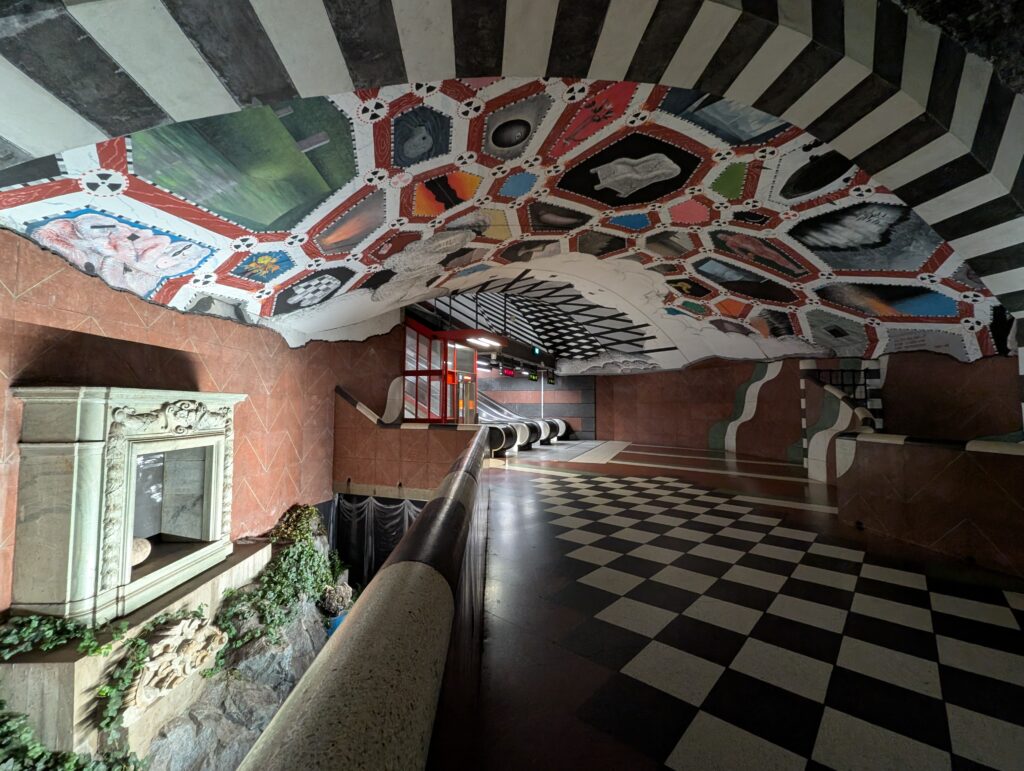
Best Time of Day to Explore the Underground Art
One of the things that made our Tunnelbanan art trip so good was the timing. We started on our travels at 10 am, and most of the stations were almost completely empty, which you can definitely see in my photos. The quieter hours make such a difference because you can take your time, get clean shots of the artwork and really enjoy the atmosphere without crowds rushing past.
Our full route took around 1 hour and 30 minutes, and it never felt rushed. You can spend longer if you want to go to more stations, but we were happy with seeing the highlights.
Tips for Exploring the Underground Art
One thing we learned quickly is that the best way to see the Tunnelbana art is to slow down and explore each platform properly. Don’t just hop off, take a photo and jump back on; some stations have artwork tucked away at the far ends, around corners or split across different sections of the platform. Walking up and down gives you a much better feel for the space and helps you spot details you’d miss otherwise.
The digital displays on every platform are super helpful, too. They show exactly when the next train is due, so you always know how much time you’ve got to wander without worrying you’ll miss the next one. It makes the whole experience relaxed, easy and perfect for dipping in and out of stations at your own pace.
Best place to start – Stadion Station – Stop #1
T-Centralen station – Red line north to Mörby Centrum – alighting at Stadion Station
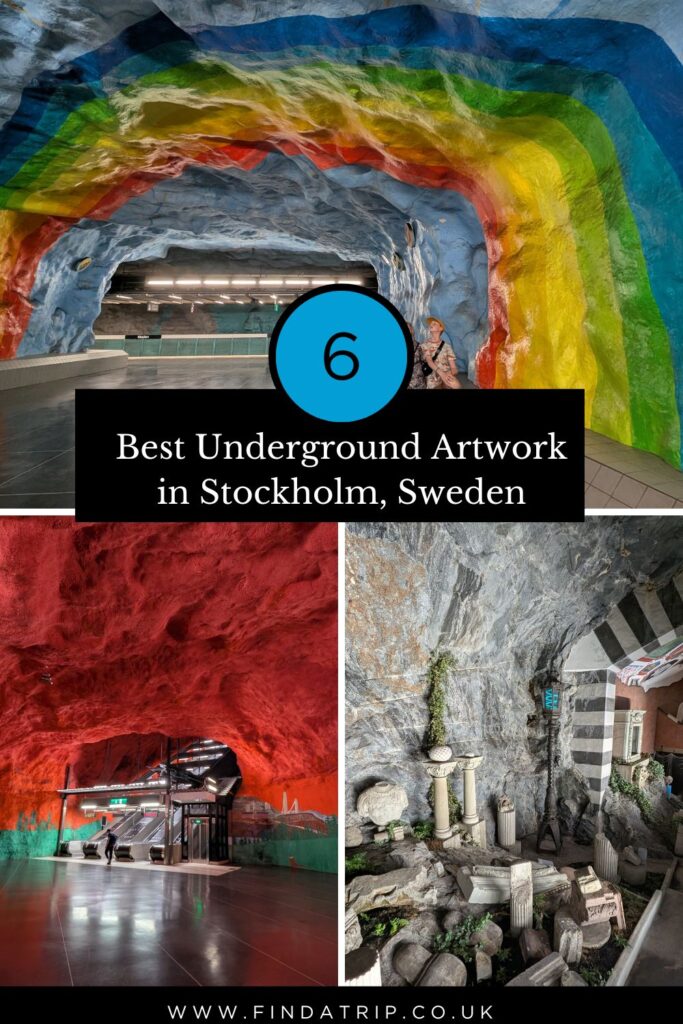
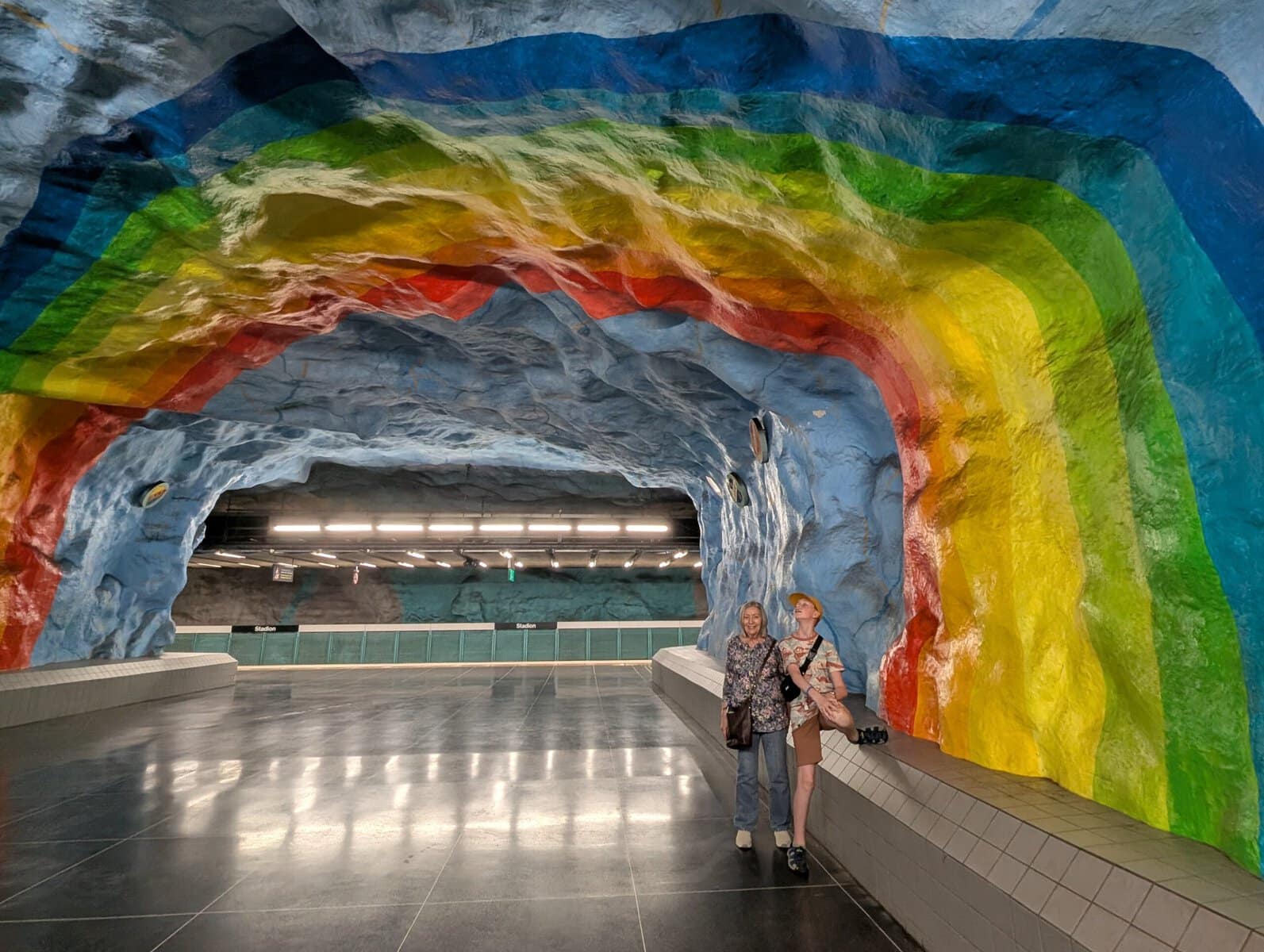
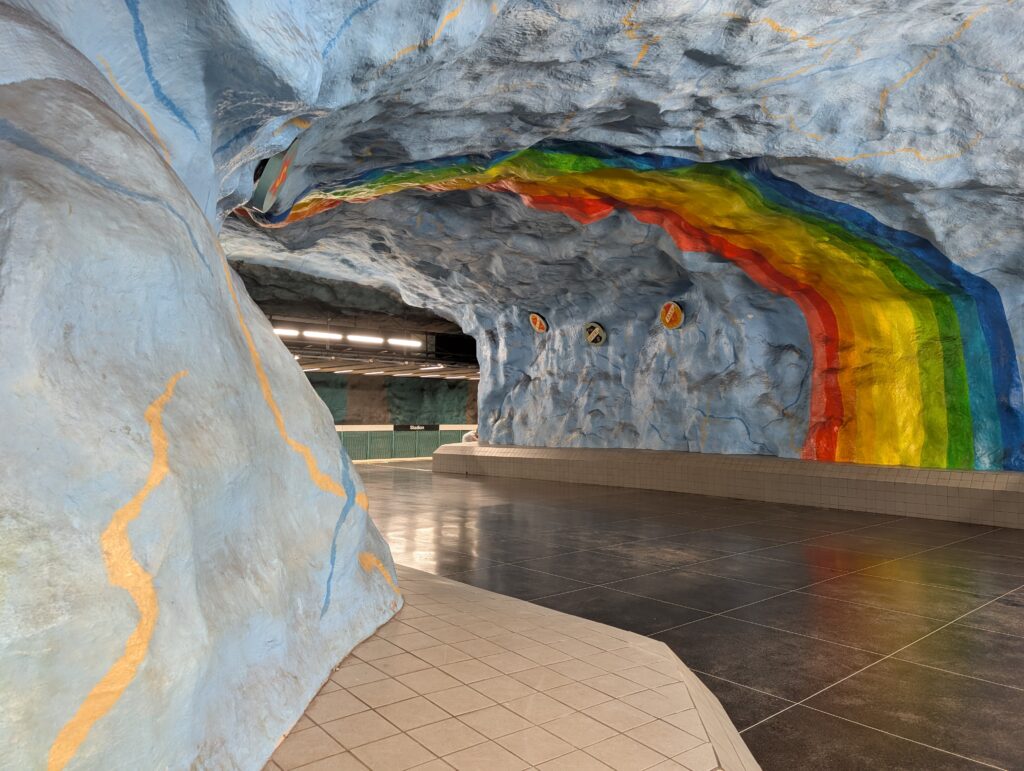
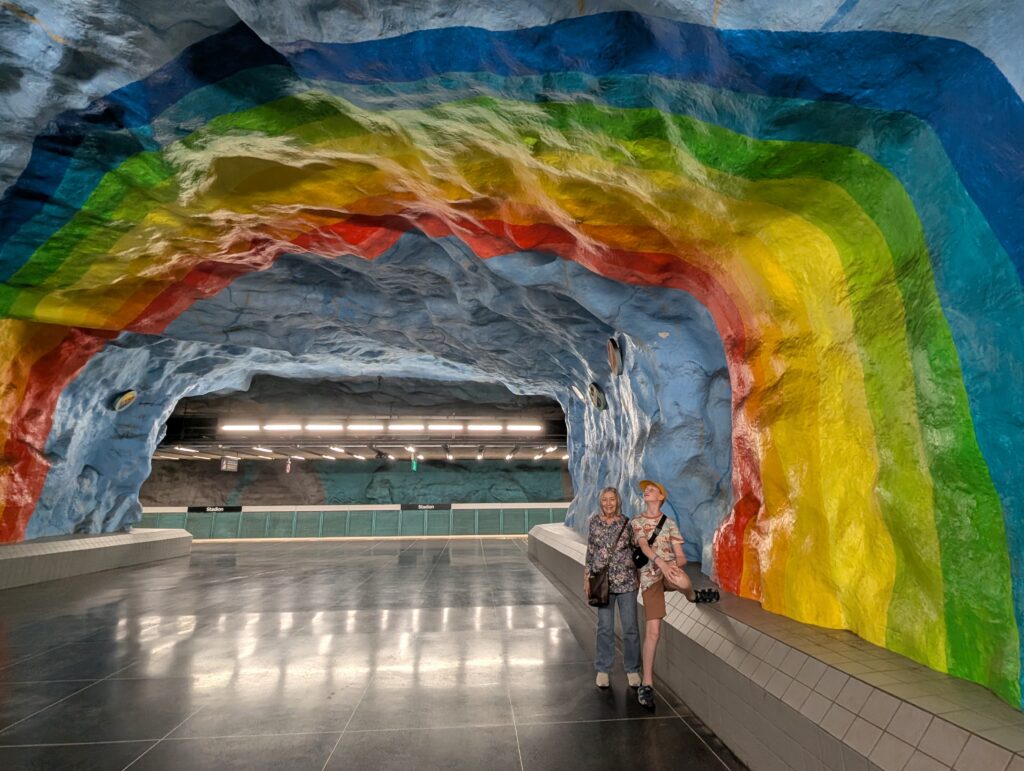
We started our route at T‑Centralen station, partly because it was right next to our hotel, but also because it’s the perfect place to begin. From there, we jumped on the Red Line heading north to Stadion. Just make sure your train is going towards Mörby Centrum rather than Ropsten. Stadion is home to one of the most iconic pieces of Tunnelbanan art, the rainbow‑painted cavern you’ll see in almost every photo or advert about Stockholm’s underground art scene. It’s even more impressive in person.
Stadion station originally opened in 1973, but the artwork arrived a few years later when artists Åke Pallarp and Enno Hallek transformed the raw bedrock into a bright, uplifting space. The design is carved directly into the exposed rock, giving it that dramatic cave‑like feel that Stockholm’s underground is known for.
The huge rainbow arch is the star of the show, created as a tribute to the nearby Stockholm Olympic Stadium and symbolising unity, joy and openness. It’s become one of the most photographed spots in the whole metro system, and standing underneath it in person feels every bit as magical as the photos suggest.
Tekniska Högskolan – Stop #2
Stadion Station – Red line north – alighting after one stop at Tekniska Högskolan
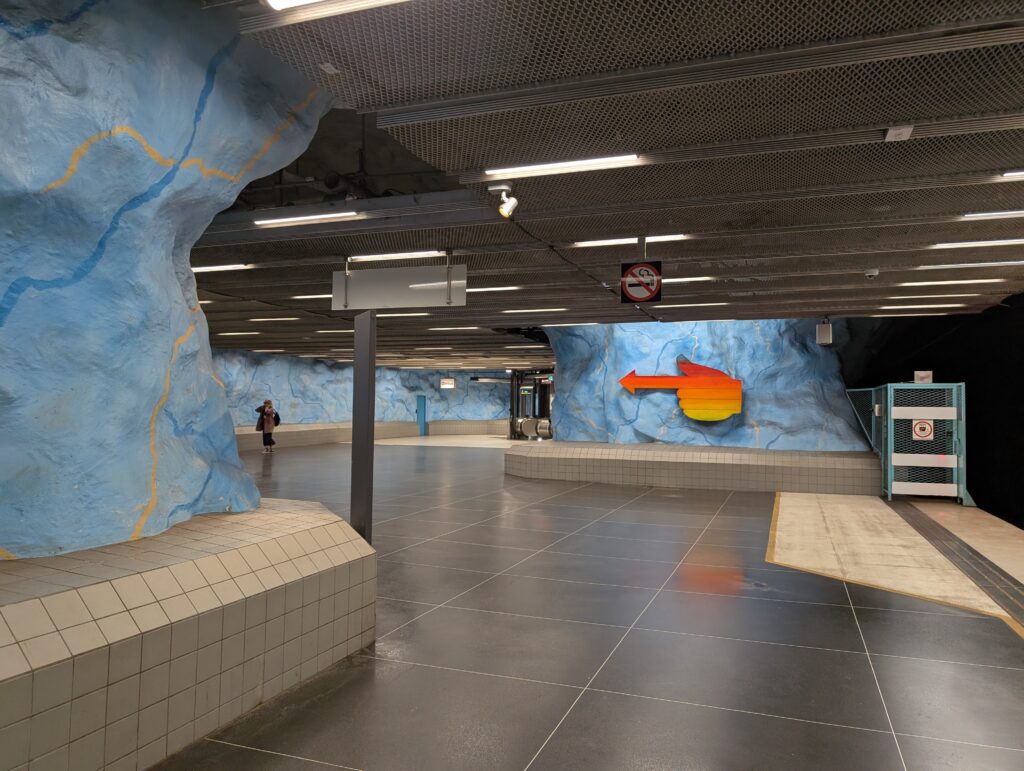
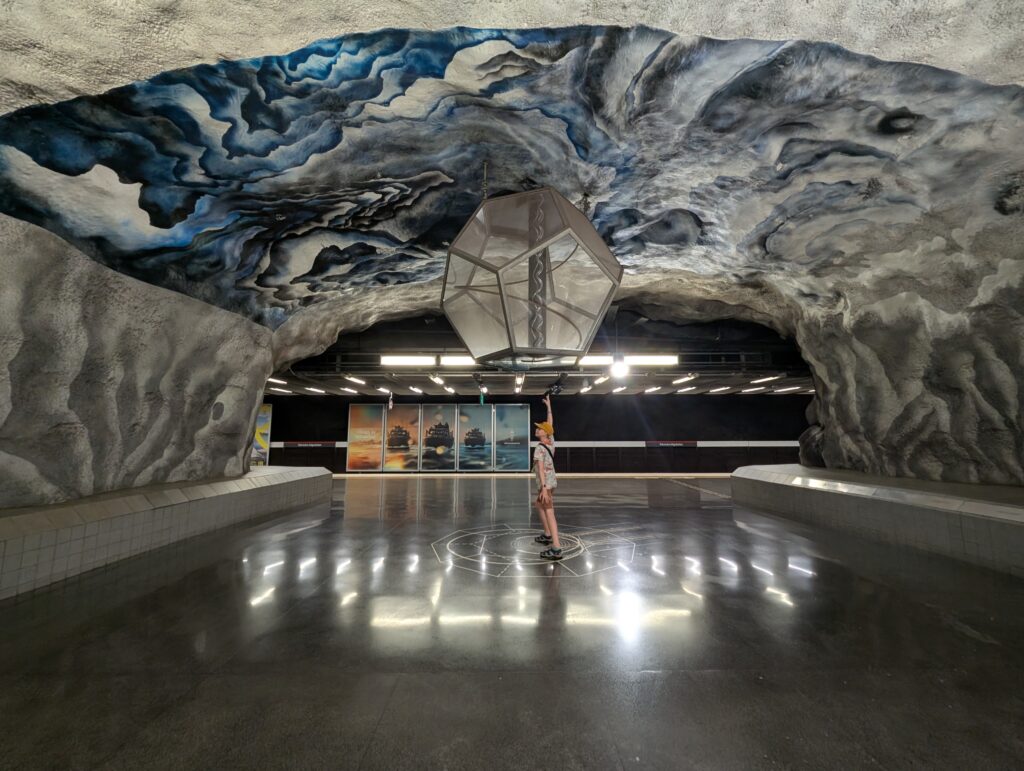
Tekniska Högskolan has a completely different vibe, more futuristic and science‑led. The station opened in 1973, and artist Lenke Rothman filled it with geometric patterns, metallic shapes and clever nods to technology, inspired by the nearby Royal Institute of Technology. Make sure you look up at the giant pendulum‑style sculpture and walk the full platform; there are smart little details hidden all the way along.
T Centralen – Blue Line station – Stop #3
Tekniska Högskolan – Red line south back to T Centralen – alighting at T Centralen and walking to the blue line
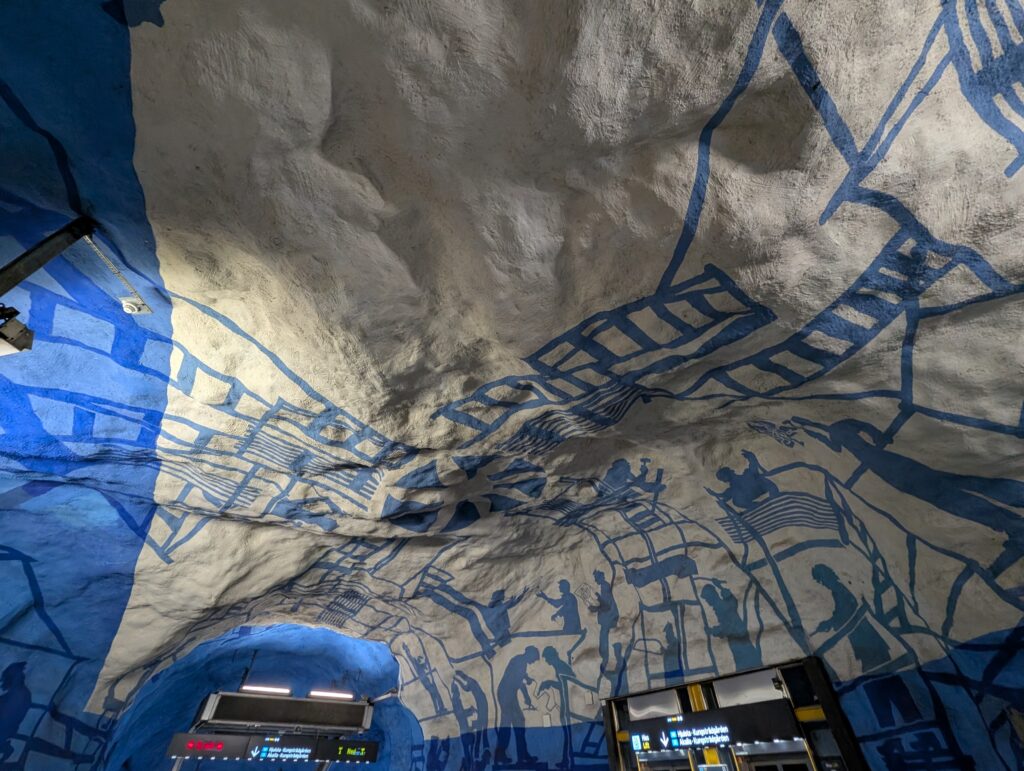
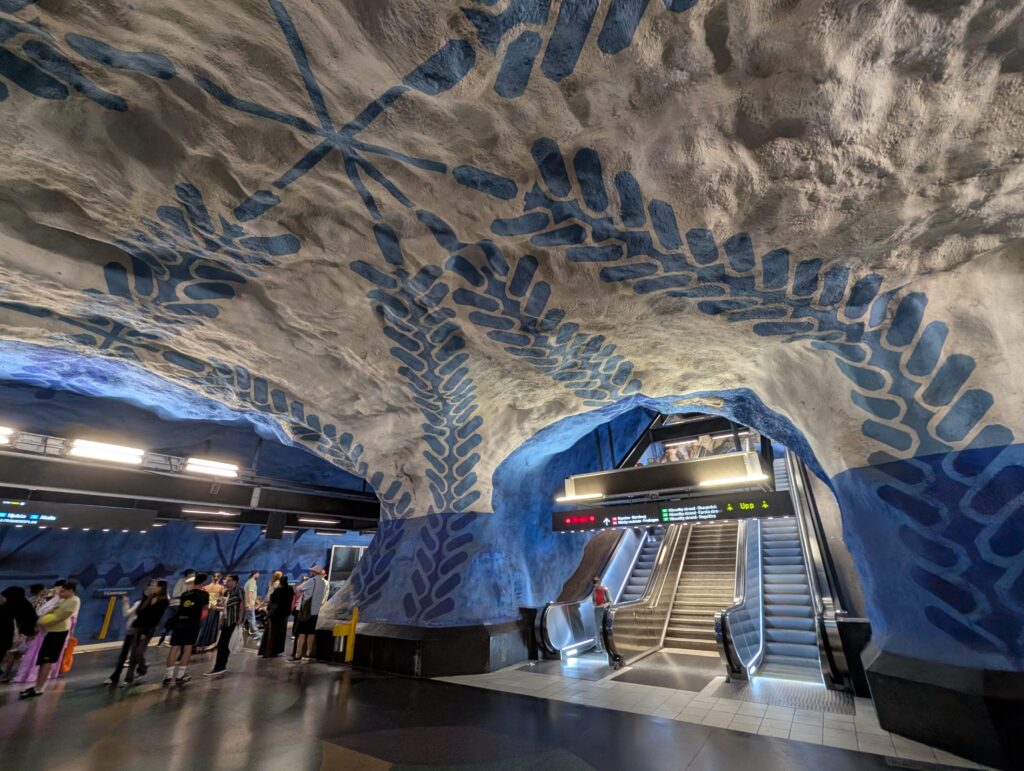
T‑Centralen’s Blue Line platforms are some of the most recognisable in the whole network, thanks to their blue‑and‑white designs painted directly onto the exposed bedrock. The artwork was created in 1975 by artist Per Olof Ultvedt, who wanted to bring a sense of softness and calm to what was then one of the busiest, most functional stations in the city. The leafy, hand‑painted motifs climb across the ceilings and down the walls, giving the whole space a cool, cave‑like feel. It’s simple but so striking, and because the art wraps around the entire platform, it’s worth walking the full length to take it all in.
Solna Centrum Station – Stop #4
T‑Centralen Blue Line northbound to Akalla or Hjulsta and ride it straight to Solna Centrum.
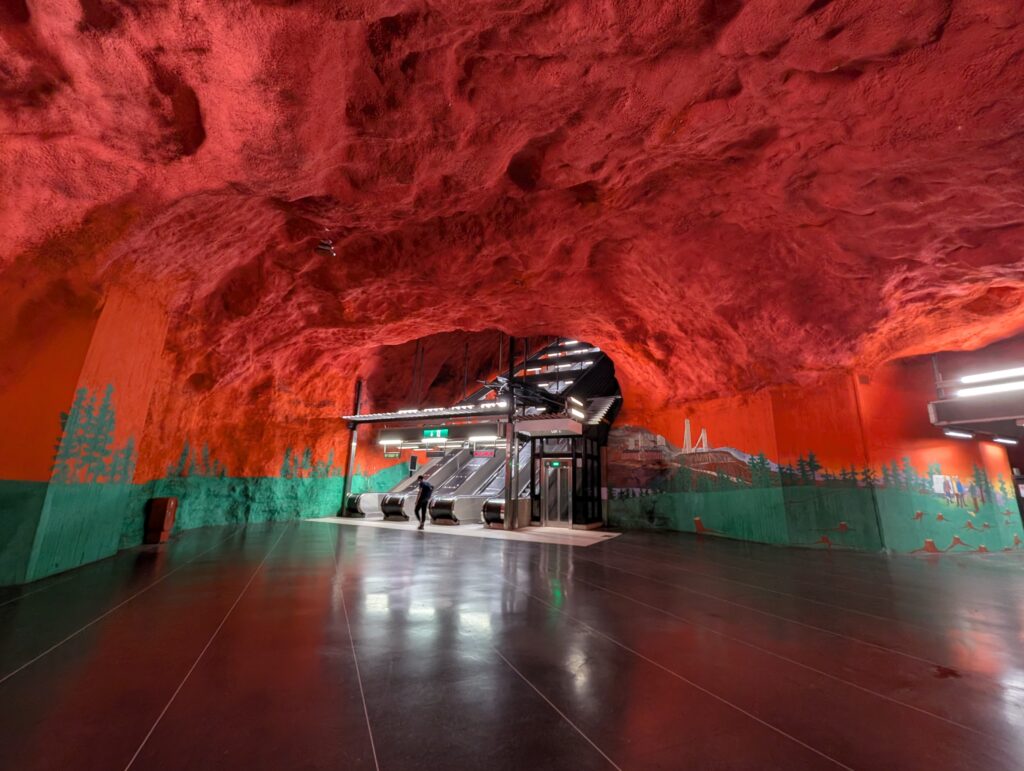
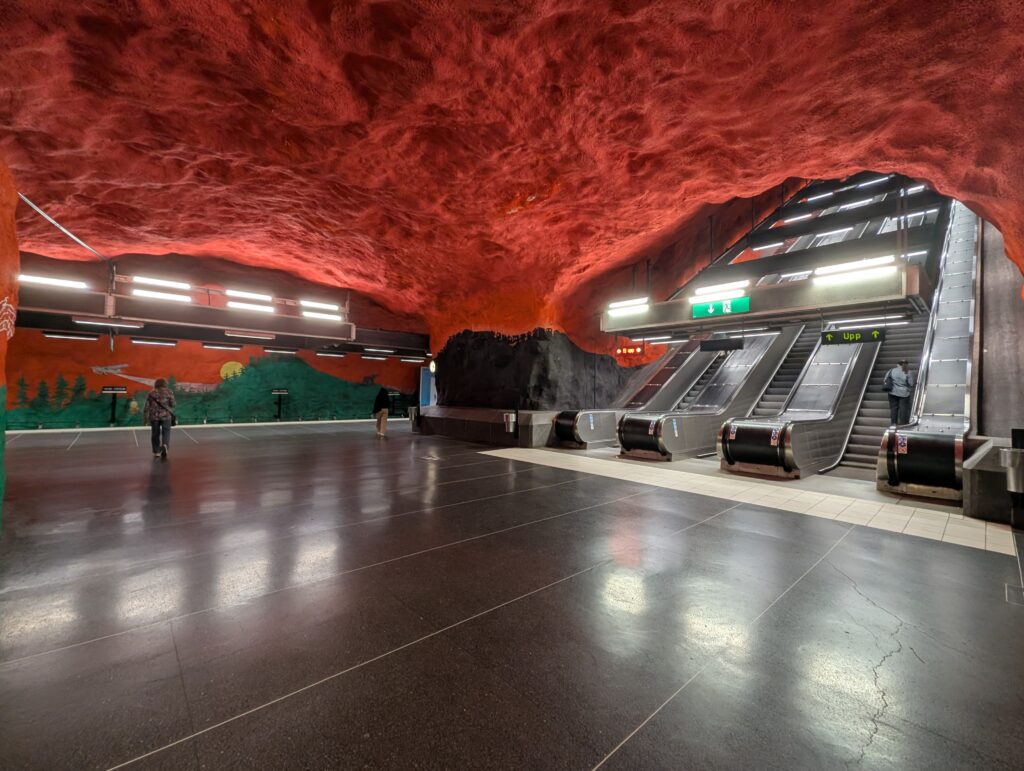
Solna Centrum is one of the most dramatic and unforgettable stations on the entire Blue Line. The station opened in 1975, and artists Karl-Olov Björk and Anders Åberg created a striking, immersive design built around a deep‑red cavern ceiling that drops into a vivid green landscape along the platform walls. The artwork represents a powerful contrast between nature and urban life, the red symbolising environmental destruction and the green depicting forests, villages and everyday Swedish life. It’s bold, cinematic and full of little details, so it’s worth walking the whole platform to take it all in.
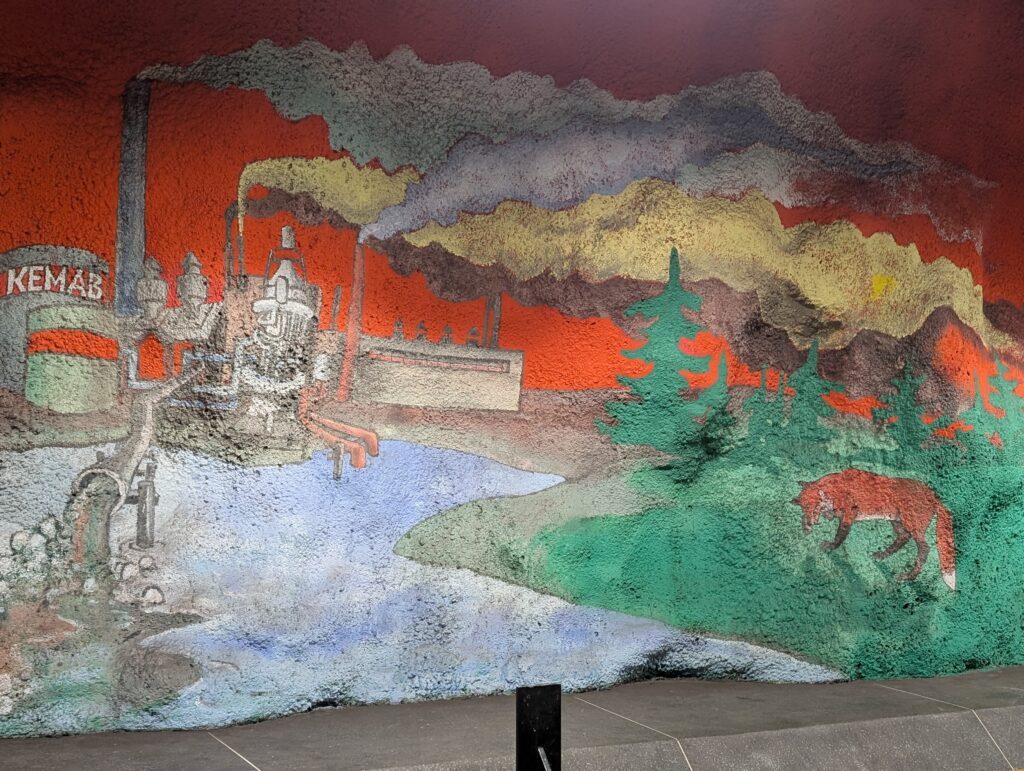
Radhuset Station – Stop #5
Solna Centrum Blue Line southbound towards Kungsträdgården and get off at Rådhuset.
Rådhuset is one of the most atmospheric stations on the Blue Line, designed to feel like you’ve stepped straight into an underground cavern. Opened in 1975, the station was created by artist Sigvard Olsson, who left the bedrock exposed and sculpted it into warm, earthy shapes that glow under the lighting. The reddish‑brown rock is meant to evoke the old courthouses and historic buildings above ground in the Rådhuset district. It’s a brilliant example of how Stockholm’s metro blends natural stone with modern design, and it’s one of those stations where the textures and shadows are just as impressive as the artwork itself. Walking the full platform really shows off how dramatic the space is.
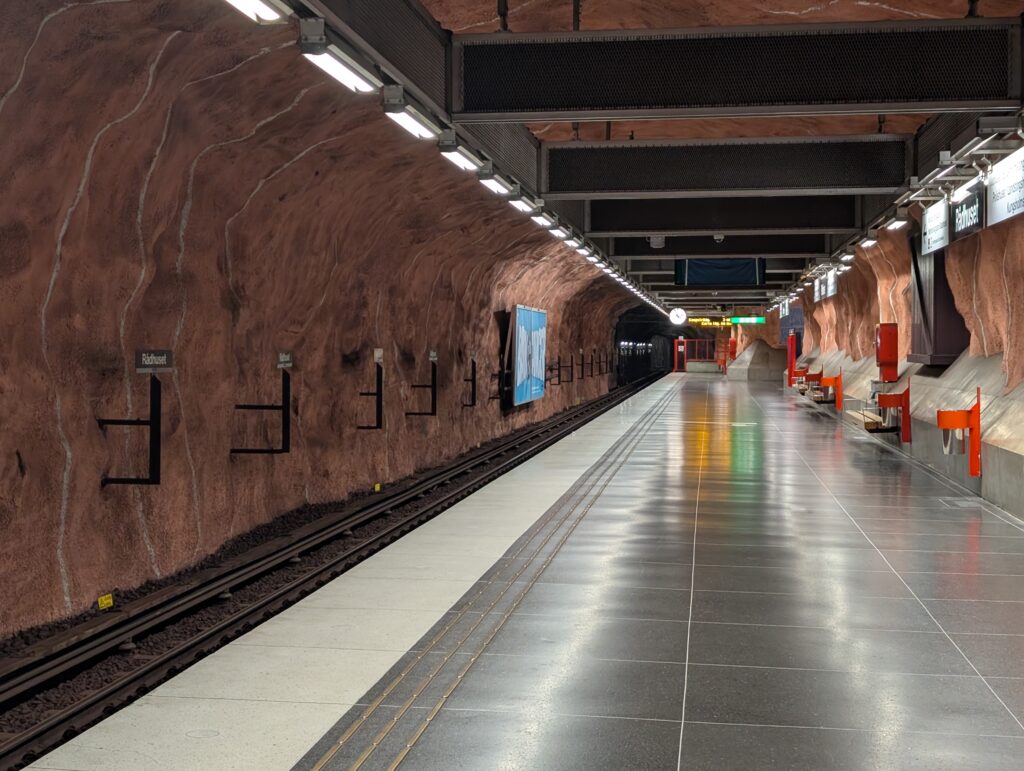
Kungsträdgården Station – Stop #6
Rådhuset Blue Line, two stops to Kungsträdgården Station
Kungsträdgården was easily the standout of the whole trail for us. It’s a station that feels more like an underground archaeological site than part of a metro system. Opened in 1977, it’s filled with carved figures, patterned floors, ancient‑style columns and fragments that look like they’ve been unearthed from a forgotten palace. Artist Ulrik Samuelson designed it to reflect the royal gardens above, so you’ll spot hints of greenery, flowing water features and plant‑like motifs worked into the rock.
The mix of bright colours, dramatic shadows and museum‑style displays makes it feel like you’re wandering through an art installation rather than waiting for a train. It’s packed with details, so give yourself time; every corner reveals something new. We then headed back to T Centralen from here.
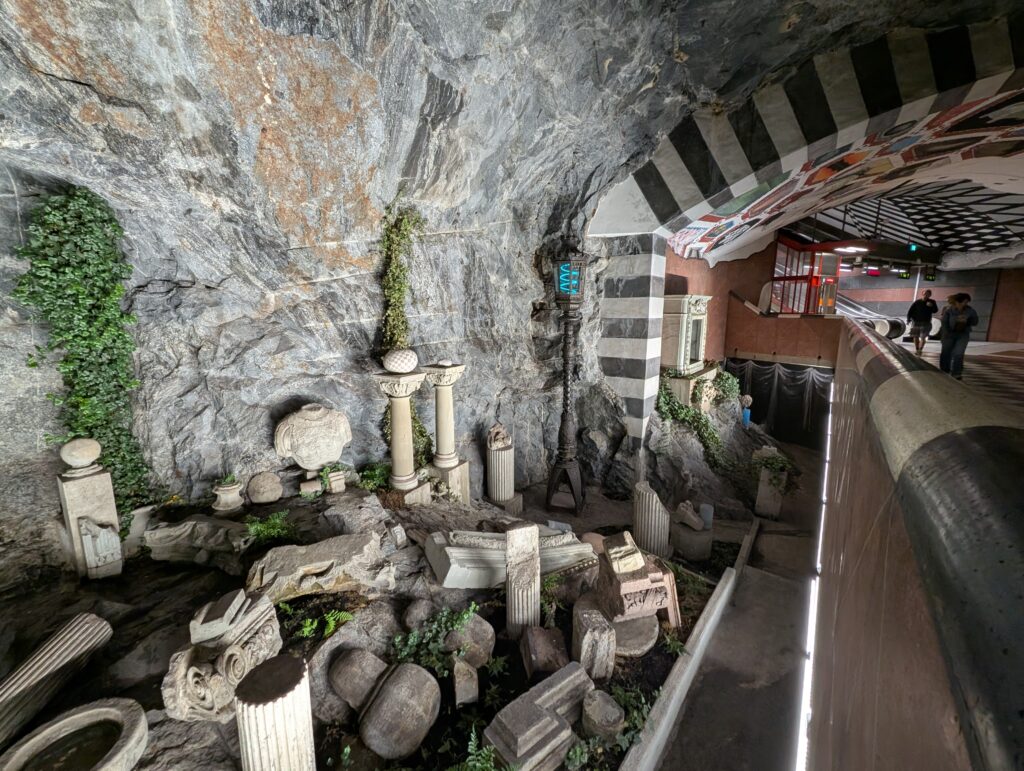
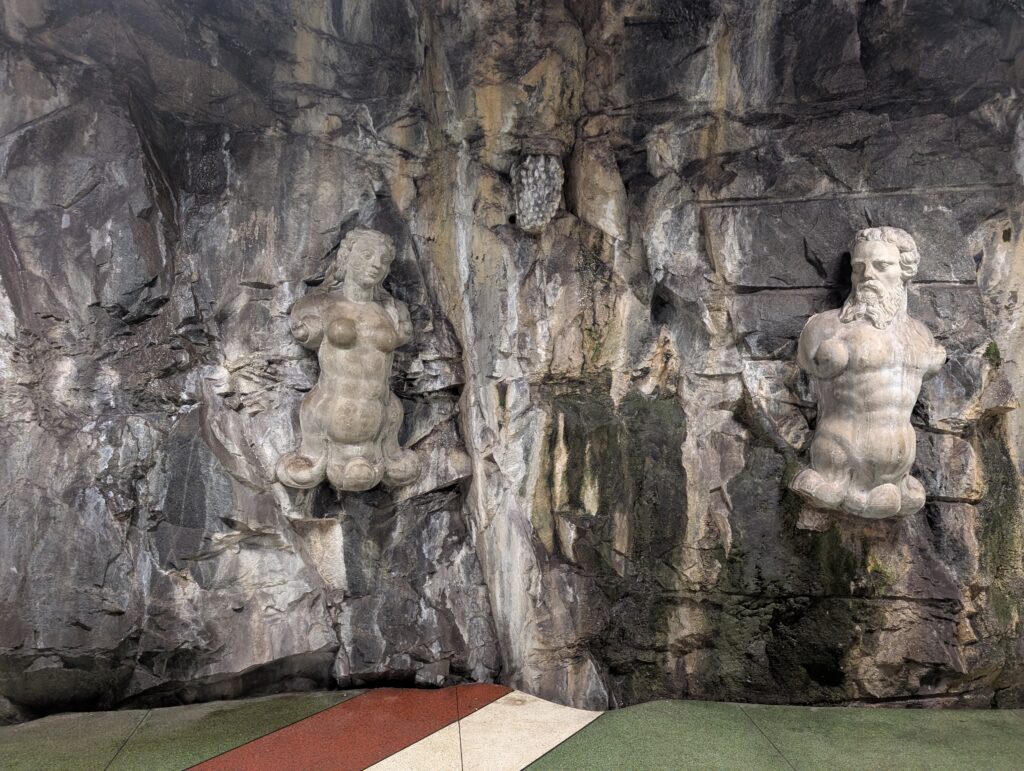
If you want to do a longer tour, here are some more stations to work into your plans.
- Universitetet – a calm, minimalist station featuring knowledge‑themed illustrations inspired by Swedish natural history and scientific discovery.
- Hallonbergen – a quirky, colourful station covered in child‑like drawings created from real children’s artwork, giving it a fun, scribbly, storybook feel.
- Tensta – a powerful station filled with multicultural motifs and messages of unity, reflecting the diverse community above ground
- Thorildsplan – a bright, playful outdoor station decorated with retro 8‑bit pixel art, including Mario‑style clouds, hearts and tunnels.
- Bagarmossen – a calm, nature‑inspired station featuring soft green tones and organic shapes that echo the forests above.
- Tekniska Högskolan – filled with science‑themed sculptures and geometric designs, inspired by the Royal Institute of Technology.
- Vreten (now Solna Strand) – a striking station with deep blue walls and glowing light installations that create a moody, futuristic feel.
Exploring Stockholm’s metro art turned out to be so much more than just getting from A to B; each station felt like stepping into a completely different world. From bold caverns and leafy blue murals to dramatic red ceilings and archaeological‑style tunnels, every stop had its own personality and story to tell. It’s such an easy, affordable way to see some of the city’s most creative spaces, and by the end of the route, we genuinely felt like we’d wandered through an underground gallery rather than a transport system. It was the perfect way to spend a few hours and a real highlight of our trip.